
Sanitary Pad Vending Machines for Offices in India: A Workplace Wellness Buying Guide
Workplace wellness policies increasingly mention one specific, practical gap: access to sanitary products during the workday. A sanitary pad vending machine for office use solves a problem that supply closets and HR requisition forms handle poorly, discreetly, at the point of need, without anyone having to ask. As more Indian companies add this to their facilities checklist alongside water purifiers and first-aid kits, the question has shifted from "should we have one" to "which one, and how do we set it up properly." This guide covers what to actually look for.
Why offices are adding this now
This isn't a regulatory mandate in most Indian states, but it has become a visible marker of how seriously a company treats day-to-day employee wellbeing. Facilities and HR teams increasingly group it with other quiet-but-essential amenities, clean washrooms, functioning water coolers, accessible first-aid, because its absence gets noticed faster than its presence. For companies with large female or mixed-gender workforces, especially in sectors like IT, BPO, manufacturing, and co-working spaces, it's become a low-cost, high-visibility addition to broader Corporate vending solutions in India rather than a standalone purchase.
How a sanitary pad vending machine actually works
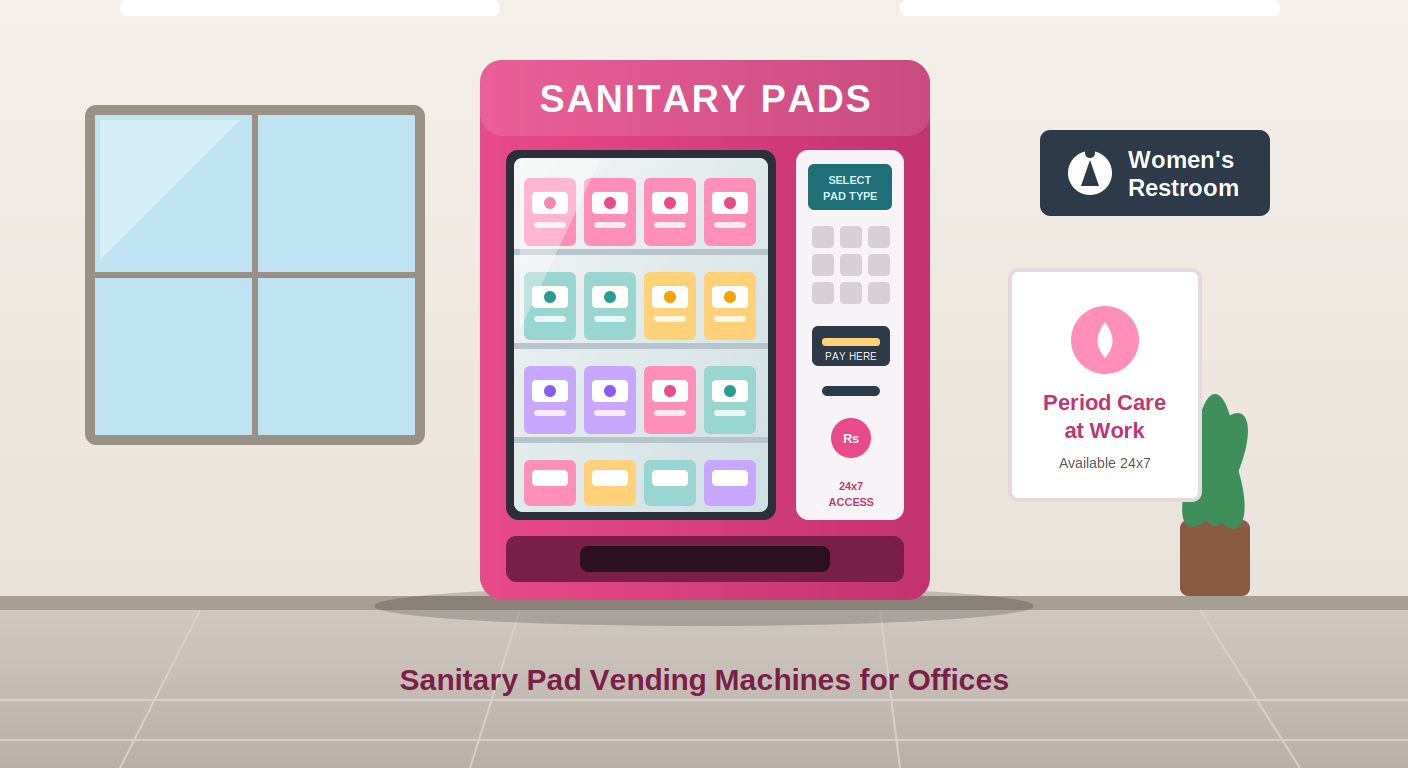
The mechanism is simpler than most people expect: a coin, card, or app-based trigger releases a single pad from a sealed, tamper-resistant compartment. Modern units skip coins entirely in favour of UPI or app-based access, which matters in Indian offices where carrying loose change isn't realistic. Units are compact by design, usually wall-mounted in or near the washroom, and sit under the same broader category as Personal Care & Mini Vending Machines rather than full snack-and-beverage kiosks, smaller footprint, lower power draw, and a narrower, hygiene-focused product range.
IoT-enabled units go a step further, flagging low stock remotely so the machine doesn't run empty for days before someone notices. That matters more here than with a snack machine: an empty sanitary pad dispenser isn't a minor inconvenience, it's a failure of the exact thing the machine was installed to prevent.
What to check before choosing a provider
• Refill and service cadence: ask how often the machine is restocked and whether refill visits are scheduled or triggered by low-stock alerts, not left to chance.
• Payment method: confirm UPI and card support, not just coin slots, since coin-operated units see lower usage in cashless Indian offices.
• Placement guidance: a provider with real facility experience should advise on washroom placement, visibility, and signage, not just drop off a unit.
• Product quality: ask which pad brand and absorbency options are stocked, and whether that can be adjusted based on usage data.
• Maintenance response time: find out what happens when a unit jams or runs empty, and how quickly a technician responds.
Where this fits into a broader wellness setup
A sanitary pad vending machine rarely sits alone. It's typically installed alongside, or as part of a phased rollout with, snack and beverage kiosks and other personal care and mini vending machines, toiletries, grooming essentials, basic over-the-counter items, as part of a single corporate vending solutions contract. Bundling it this way usually means one service relationship, one refill schedule, and one point of contact instead of juggling separate vendors for separate machines.
For companies rolling this out across multiple office locations, including Delhi-NCR, consistency matters more than any single feature. A provider operating across cities, rather than a local-only installer, can usually standardize placement, pricing, and service response regardless of which city a given office sits in. For Delhi-based teams specifically, local service turnaround is worth confirming directly, since a sanitary pad vending machine in Delhi still needs the same refill reliability as anywhere else, just with a provider who actually has technicians in the city.
Cost and contract structure
Most providers in India work on either a managed-service model, the machine, refills, and maintenance bundled into one monthly or per-unit cost, or an outright purchase with a separate annual maintenance contract. For a single washroom unit, the managed-service route is usually simpler for facilities teams, since it avoids managing a separate consumables budget line. Larger offices with multiple washrooms or campuses sometimes negotiate a flat per-site rate instead. Either way, ask for the full breakdown before signing: machine cost or rental, refill cost per unit, and any minimum contract period.
Full details on machine formats and what's included in a typical corporate vending solutions setup are on our Tech & Solutions page, and you can reach out through our contact form for a site assessment specific to your office layout.
Frequently Asked Questions
Is a sanitary pad vending machine mandatory in Indian offices?
It isn't a universal legal mandate in most states, but it's increasingly treated as a standard part of workplace wellness policy, especially in offices with large female or mixed-gender workforces.
Where can I get a sanitary pad vending machine in Delhi?
Providers operating across Delhi-NCR can install and service a sanitary pad vending machine Delhi offices need, with the same refill reliability expected anywhere else, provided they have local technicians rather than a fly-in service model.
Does a sanitary pad vending machine accept UPI?
Modern units typically support UPI, card, and app-based payment in addition to or instead of coins, which suits cashless Indian offices far better than coin-only dispensers.
How often does the machine need to be refilled?
Refill frequency depends on usage and should be based on IoT-flagged low-stock alerts rather than a fixed schedule, so the unit doesn't run empty between visits.
Can a sanitary pad dispenser be bundled with other vending machines?
Yes. It's commonly installed alongside snack, beverage, and other personal care and mini vending machines under one corporate vending solutions contract, which simplifies service and billing.
What's the typical contract model for offices?
Most Indian offices use a managed-service model covering the machine, refills, and maintenance in one cost, though outright purchase with a separate maintenance contract is also available for larger sites.